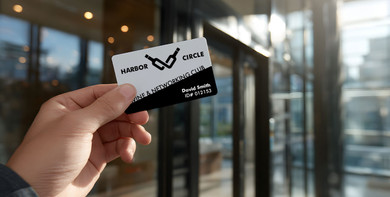
Membership cards seem simple on the surface — a small printed card with a name and a logo - but the choices you make when selecting them can have a real impact on member satisfaction, operational efficiency, and even your organization's bottom line. Whether you're running a gym, wine club, alumni association, private club, museum, nonprofit, or a professional association, this helpful guide will walk you through everything you need to know to help you choose the right member cards for your specific situation.
Why Printed Membership Cards Still Matter in a Digital World
With apps and digital wallets becoming more prevalent, it's fair to ask: do physical printed member cards still hold value? The short answer is yes — and for several reasons.
Custom printed plastic cards add to your members' sense of belonging and create a level of prestige that a phone app simply can't replicate. When a new member receives a well-designed, high-quality card in the mail, it reinforces that joining your organization was a worthwhile decision. That perceived value can positively impact retention. Studies on customer loyalty consistently show that tangible, branded items increase emotional connection to an organization.
Membership cards for clubs also serve practical purposes:
1. Identification or proof of membership
2. Access control via barcode, QR code, magnetic stripe, RFID or NFC technology chip
3. Provide custom loyalty card discounts or VIP rewards
For many organizations, they remain an essential operational tool that can elevate your membership program — not just a nice-to-have printed item.
Step 1: Identify How You'll Use & Distribute the Cards
Before you start thinking about design or materials, decide exactly what function your membership cards need to serve and how you'll go about distributing them to members. This will drive nearly every other decision.
Identification. Most organizations require a card that displays a member's name, member number, and/or expiration date. In their simplest form, they will be produced as a value-add when joining or renewing with your club, group, or organization and may have no other functional use. Others will serve as ID badges with unique photographs, added security features, or additional functionality.
Access control. If your card needs to open a gate, unlock a door, or grant entry to a facility, you'll need a card embedded with a magnetic stripe, barcode, QR code, or RFID chip. Each technology has different hardware and software requirements on the reader side, so it's important to have a solution in place before committing to a card type to ensure compatibility.
Loyalty and rewards. Cards tied to a points system or loyalty program typically need a barcode, QR code, or magnetic stripe that integrates with your POS software. Make sure your member cards are produced to match your system's specifications.
Fulfillment and mailing. If you plan to send cards directly to members rather than distributing them in person, you'll want to think about whether a card alone is sufficient or if you need a complete fulfillment solution with on-demand personalization. This can be as simple as a personalized card adhered to a welcome letter, inserted into an envelope, and mailed directly to members or something more elaborate like a customizable boxed welcome kit with swag. We specialize in this kind of automated fulfillment at Print Robot, which saves organizations significant time and labor.
Step 2: Choose Your Card Material
The most common material for membership cards is PVC plastic, the same material used in standard credit cards. A typical card is 30 mil thick — sturdy enough to survive in a wallet without cracking or fading.
Here's a quick breakdown of the main material options:
Standard PVC Plastic
Durable, professional, and the industry standard. Plastic cards hold up to everyday handling, work with all standard card printing processes, and supports magnetic stripes, embossing, and chip embedding. This is the right choice for most organizations. While 30 mil (credit card thickness) is the most popular, they can be produced as thin as 12 mil or as thick as 50 mil depending on your needs.
Eco-friendly Paper Cards
Our 28 pt engineered paper cards, PaprCard™, provide a similar feel and thickness to plastic with a more environmentally responsible profile. These are increasingly popular with nonprofits and organizations whose members value green initiatives.
Step 3: Decide on Personalization — and When You Need It
One of the most overlooked decisions in the membership card process is when personalization happens. There are two primary models:
Single Batch Personalization
Your entire list of member names and IDs is submitted at once, cards are printed and personalized in one production run, and the completed cards are shipped to you for distribution. This works well for organizations that onboard members on a defined schedule — annual renewals, event-based programs, or academic year cycles. It's the most straightforward approach and typically the most cost effective solution as long as each order has a minimum quantity of 100.
On-demand Personalization
For organizations with members joining throughout the year, a single annual batch doesn't cut it. A prepaid shell program solves this elegantly: a large batch of card "shells" — fully printed with your logo and design but without individual member details — is produced upfront and stored. Whenever new members join, you simply submit a spreadsheet of names and IDs, and the shells are personalized on-demand and shipped within days.
Our prepaid shell program is particularly well-suited to associations, museums, clubs, and other membership organizations where enrollment is continuous. Several golf and country clubs, for example, use this model to ensure that a personalized card and welcome letter are placed in the mail within about a week of every new member joining — without the organization having to manage any of the production logistics themselves.
Step 4: Think Through Your Card Design
Your membership card is often the first physical touchpoint a new member has with your brand. It's worth investing time in getting the design right.
A few principles to keep in mind:
Legibility matters. Member names, ID numbers, and expiration dates need to be easy to read at a glance — both for the member and for anyone checking the card at a door or front desk. Avoid cluttering the card with too much information.
Brand consistency. Your card should feel like it belongs to the same family as your other branded materials: website, letterhead, signage. Use your established color palette, fonts, and logo treatment.
Plan for the back of the card. Many organizations focus all their attention on the front and leave the back as an afterthought. The back is a valuable piece of real estate — consider using it for a website URL, a short tagline, emergency contact information, or links to social media. Incorporating a QR code to upcoming events or web links can give added flexibility for sharing content that is subject to change.
Get a digital proof before you commit. We always provide a digital proof for your approval before starting your print project. Print Robot also offers complimentary design services in case design isn't your strong suit. Our team will work from your logo and brand guidelines to create a print-ready design, including a digital proof so you can see exactly how the cards will look before placing your order.
Step 5: Evaluate Card Upgrades and Add-Ons
Once you've settled on the basics, consider whether any of these upgrades and customization options make sense for your use case:
- Magnetic stripe: Can be just "for show" or if you plan to swipe them, provide encoding details to ensure compatibility with your POS or access control system.
- Barcode or QR code: A cost-effective alternative to magnetic stripes for scanning and lookup purposes.
- RFID/NFC chip: Order with an embedded RFID or NFC chip to enable contactless scanning for high-security or high-traffic access points.
- Embossing: Raised lettering adds a premium, credit-card feel — popular for high-tier memberships.
- Foil stamping: A metallic foil accent on your logo or card border can elevate the perceived value significantly and provided added security.
- Hole or slot punch: Useful if members will clip the card to a lanyard or badge holder.
- Sequential numbering and variable data: Add a unique member name, number, and/or expiration date to every card.
- Member photo: While it does add to the cost, a unique member photograph can be added to make it an ID card with added security.
Not every organization needs these features, or has the hardware / software in place on their side, but it's worth knowing they're available if needed.
Step 6: Understand Turnaround Times and Plan Accordingly
Membership card printing takes time, and organizations frequently underestimate the lead time required — especially for annual renewals where cards need to arrive before the new membership year begins.
Standard production time to print custom membership cards runs 10–15 business days after proof approval for a single batch. If you're using a prepaid shell program, the initial batch of shells follows the same timeline, but once the card shells are complete, subsequent personalizations are typically mailed out in under a week.
If you have a hard deadline — a board meeting, annual gala, renewal mailing, or the start of a new season — let us know! Rush turnaround is usually available for an additional fee if you are running short on time.
Step 7: Consider the Full Member Experience
Finally, zoom out and think about custom printed membership cards as one piece of a larger member onboarding experience. A card that arrives loose in a plain envelope feels very different from a card adhered to a personalized welcome letter, tucked into a branded envelope, and delivered directly to the member's door.
If your organization relies on personalized membership cards to make a strong first impression — and most should — it's worth considering whether a complete fulfillment solution fits your needs. Automated fulfillment services allow for on-demand personalization, letter printing, card adhering, folding, inserting, sealing, and mailing, so your staff can focus on member engagement rather than production logistics.
Choosing the Right Vendor
Not all membership card printers are created equal. When evaluating vendors, look for:
- Domestic production (shorter lead times, easier communication, quality control)
- Design support (especially if you don't have an in-house designer)
- Fulfillment capabilities (if you need direct-to-member mailing)
- Transparent pricing (instant online pricing is a good sign of a straightforward operation)
We are proud to check all of these boxes here at Print Robot. Based in Deerfield Beach, Florida, we manufacture plastic cards, paper cards, and a full range of printed products from our 55,000 sq. ft. South Florida factory. Our parent company has been in business for over 40 years. We can handle everything from design to plastic card printing to fulfillment, making us a strong one-stop option for membership organizations and clubs of all sizes. You can request free samples to evaluate the quality firsthand before placing an order.
Final Thoughts
Choosing the right membership cards comes down to understanding your members, your operational workflow, and the impression you want to make. Take the time upfront to map out how the card will be used, who will receive it and when, and what the full delivery experience should look like. The right custom plastic membership card — well-designed, properly personalized, and professionally delivered — is a small investment that pays dividends in member loyalty and organizational credibility for years to come.
Questions? Call us at 800-547-6624 or contact Print Robot to schedule a Zoom meeting to answer any questions you may have.
Ready to get started?