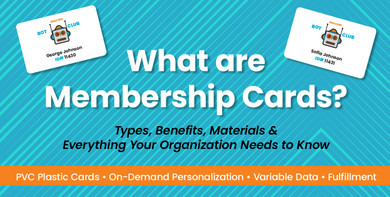
A membership card is a physical credential that proves a person belongs to an organization, program, or club. It grants access, triggers benefits, and serves as a daily reminder of that membership. It sits in a wallet, visible and tangible, every time it's opened.
But it's much more than that. A well-made membership card is a brand asset, a data collection tool, an access mechanism, and a psychological anchor all in one. For gyms, golf & country clubs, nonprofits, spas, car washes, museums, associations, and clubs of every kind, it's often the first physical thing a new member receives. That first impression matters as it can positively affect the perceived value of their membership.
This guide covers everything: what membership cards are, what they're made of, why they drive retention, and which format is right for your organization.
What Are Membership Cards?
A membership card is a physical credential issued by an organization to confirm that an individual is an active, recognized member. In its simplest form, it serves five core functions:
- Proves identity
- Grants access to facilities, events, or services
- Triggers member benefits and discounts
- Collects data when scanned
- Reinforces a sense of belonging every time it's seen or used
The standard format is CR80, the same size and thickness as a credit card (3⅜" × 2⅛", 30 mil thickness), printed on PVC plastic or 28pt engineered paper cards.
Many membership cards are just for show while others can be scanned or swiped to perform a specific function using a magnetic stripe, barcode, QR code, or embedded RFID technology chip according to the organization's access or POS system requirements.
A Brief History
Membership cards started as simple, thin paper credentials. As organizations grew and fraud became a concern, laminated cards replaced paper. PVC plastic followed: durable, wallet-friendly, and printable with high-quality graphics.
A variety of optional upgrades came next including personalizing each card with a unique name and number, barcodes and QR codes which can be scanned at check-in, magnetic stripes integrated with POS systems, and RFID and NFC chips enabled fully contactless access.
Digital solutions came on the scene when smartphones became standard issue and it was thought that printed cards would go away but an interesting thing happened. Many organizations that shifted towards a digital-only solution received so much negative feedback that they switched back to physical cards or a hybrid solution.
Today, whether your membership solution is simple or sophisticated, a single personalized plastic card can be designed to fit your members' needs — and still slip into their back pocket.
Membership Card vs Other Card Types
These are often confused, but each serves a distinct purpose.
|
Card Type |
Primary Function |
Key Difference |
|
Membership Card |
Proves belonging, can grant access or unique discounts and benefits |
Identity + access + benefits combined |
|
Loyalty Card |
Tracks purchases, rewards repeat customers |
Transactional - No identity or access |
|
ID Card |
Provides identification |
Identification is primary use |
|
Gift Card |
Stores prepaid monetary value |
No membership, no access, no identity |
|
Access / Key Card |
Controls door access at hotels and places of business requiring security |
No identity or benefit layer |
Types of Membership Cards
Optional Upgrades By Technology
The technology encoded into a card determines what it can do and which systems it works with.
- Standard personalization: Features logo, member name, member ID, and any additional necessary printed text only. For organizations with manual check-in or value-add cards that don't need to perform a function.
- Barcode (1D): A printed pattern of vertical lines read by a scanner. Fast, reliable, compatible with most POS and gym systems. Most popular formats include Code 128 and Code 39 barcodes.
- QR code (2D): Scannable by smartphone or reader. Can link to a member profile, benefits page, or event check-in. Data linked digitally via dynamic QR codes can be updated online without reprinting.
- Magnetic stripe: Swiped through a reader. Up to three data tracks store member ID, account number, and additional details. Available in LoCo or HiCo magnetic stripe and can integrate with most retail and hospitality POS systems.
- RFID: Communicates with a reader without physical contact. (Think hotel key card.) No line of sight required. Ideal for automated access: car wash bays, gyms, gated facilities, anywhere require secure door access.
- NFC: This smartphone compatible technology-embedded chip allows members to tap their phone to the card to trigger an action: unlock a URL, verify identity, or initiate check-in.
By Membership Tier
Tiered cards do more than differentiate access levels. They create visible progression that drives upgrade behavior.
- Standard / Basic: entry-level access
- Silver, Gold, Platinum: each tier is a physical upgrade in finish, color, or material
- Lifetime: no expiration date, premium signal, strong identity anchor
- Annual / Expiring: expiration date creates a natural renewal trigger
- Guest / Temporary: limited-use credential for short-term or trial members
By Physical Format
- CR80 (credit card size): 3⅜" × 2⅛", fits every wallet, industry standard
- Key tag / Fob: attaches to a keychain, popular for gyms and car washes
- Combo Card: a CR80 card with a snap-off key tag attached
- Custom Shapes: available on request for unique brand requirements
What Are Membership Cards Made Of?
Material
The vast majority of membership cards are made from PVC plastic at 30 mil thickness, the same as a standard credit card. PVC is durable, waterproof, scratch-resistant, and compatible with thermal card printers for in-house personalization. Plastic cards last 3 to 5 years - or longer - under normal daily use and heat conditions.
Standard CR80 Dimensions
|
Specification |
Value |
|
Width |
3⅜ inches / 85.6mm |
|
Height |
2⅛ inches / 53.98mm |
|
Thickness |
30 mil / 0.76mm |
|
Corners |
Rounded (standard) |
Finish Options
- Gloss: vibrant colors, high shine, most popular finish
- Matte / Satin: premium feel, fingerprint-resistant, sophisticated and understated
- Spot UV: selective gloss highlights on specific design elements against a matte base
What Gets Printed on a Card
Front: Organization logo, member name, member ID, tier designation (optional), expiration date (optional)
Back: Any relevant contact details, website and social media URLs, and/or membership benefits. Optional upgrades may include barcode or QR code, magnetic stripe, or signature panel.
|
The back of a card is often underused. A QR code linking to a member benefits page, upcoming events, or a renewal portal turns dead space into a functional touchpoint that can be updated online as needed unlike text that is physically printed on the card. |
Security and Premium Features
|
Feature |
What It Does |
Best For |
|
Embossing |
Raised lettering pressed into the card surface |
Premium tier cards, prestige programs |
|
Hologram overlay |
Anti-counterfeiting visual security layer |
High-security credentials |
|
UV printing |
Ink visible only under UV light |
Fraud prevention |
|
Signature panel |
Area for members to sign |
ID verification at point of access |
|
Slot punch |
Hole for lanyard or badge holder |
Events, conferences, staff cards |
Technology Inside Membership Cards
How Each Encoding Technology Works
Barcode (1D): A printed pattern of parallel lines read by a laser. Stores a string of numbers or characters, typically a member ID or account number. Requires a fixed scanner or handheld reader. Fast and widely compatible. Most popular formats include Code 128 and Code 39.
QR Code (2D): A matrix of black and white squares readable by any smartphone camera. Static QR codes carry fixed data; dynamic QR codes point to a URL containing information that can be changed digitally at any time without reprinting the card.
Magnetic Stripe: A strip of magnetized particles that stores data across up to three tracks. Track 1 holds alphanumeric data (name, account), Track 2 holds numeric data (ID number), Track 3 is used for financial data in some applications. Magnetic stripes can be either HiCo (high-coercivity) or LoCo (low-coercivity). Check your POS system for compatibility requirements.
RFID: A chip and antenna embedded in the card communicates with a reader using radio waves at 125kHz. The reader's electromagnetic field powers the chip. Works at close range without physical contact or line of sight. Access control software determines which doors / devices are accessible.
NFC: A subset of RFID operating at 13.56MHz. Compatible with modern smartphones. Members can tap their phone to an NFC card or reader to trigger a specific action. Typically loading a URL, profile, or contact details.
Variable Data Printing
Variable data printing (VDP) allows each card in a print run to carry unique information: a different name, member ID, expiration date, or even photo on every card, produced in one continuous batch.
The process uses a data file (typically CSV or Excel) where each row represents one member. The print system reads the file and applies the corresponding data to each card as it's printed. The result: 500 personalized cards produced as efficiently as 500 identical ones.
|
Personalized cards are significantly less likely to be discarded. A card with a member's name on it feels like it is unique and belongs to them. |
The Backend System
Membership cards that perform some type of physical functionality don’t work in isolation. Every scan, swipe, or tap must connect to a membership management system, POS, access control, or other software/hardware that performs the needed action. The card is simply the physical interface. The system behind it is what turns that card into a functioning tool.
Benefits of Membership Cards
For the Organization
- Passive brand exposure: a card in a wallet generates impressions every day with no ad spend and no algorithm
- Stronger member retention: physical possession creates psychological commitment that digital credentials don't replicate
- Offline access control: barcode and RFID systems work without internet, app updates, or charged devices
- Member data collection: every scan is a data point on frequency, usage, and lapse risk
- Tiered upgrade revenue: visible tier differentiation (Silver to Gold to Platinum) creates a clear upsell path
- Fraud reduction: a PVC card with encoding and security features is significantly harder to forge than paper or a screenshot
For the Member
- Immediate proof of status: no phone, no app, no charge required
- Tangible sense of belonging: physical possession creates ownership and connection
- Universal access: works regardless of device, operating system, or tech comfort level
- Status and prestige: especially with tiered or premium-finish cards
The Psychology of Membership Cards
This is the layer most organizations overlook. It's where physical cards consistently outperform digital alternatives.
Belonging Is a Core Human Need
Abraham Maslow, a pioneering American psychologist best known for developing the Hierarchy of Needs theory, placed belonging just above basic survival in his hierarchy of needs. People don't join organizations purely for discounts or access. They join to be part of something. A physical card makes that belonging concrete. It's not just a credential; it's a tangible representation of identity.
The Tangibility Effect
Physical objects create stronger psychological ownership than digital equivalents. A card in a wallet is a daily, subconscious reminder of membership. Digital cards buried in a phone menu are forgotten between visits. The presence of a physical object triggers recall and reinforces the decision to stay connected.
Social Identity Theory
People integrate the groups they join into their own self-definition. A member of a golf club, a professional association, or a fitness community carries that identity. The card reinforces it. Every time it's seen in the wallet, it quietly confirms: I am a member of this. I belong.
The Endowed Progress Effect
Tiered cards work because of a well-documented psychological principle: people are more motivated to complete a goal when they can see progress toward it. Silver, Gold, Platinum: each physical upgrade signals advancement. An upgrade in digital status feels abstract; a new card at an upgraded tier feels like an achievement.
Loss Aversion and Expiration Dates
People fear losing something they have more than they value gaining something new. An expiration date on a physical card makes the loss of membership feel imminent and real. It's a natural prompt that renewal is simply part of the program. First-year member renewal rates average around 72%; renewals tend to increase when members receive a quality card shortly after joining to reinforce the value.
Who Uses Membership Cards?
Membership cards are used across virtually every sector where organizations have recurring members, subscribers, or program participants.
Associations and professional organizations use them to confer professional standing, grant event access, and drive annual renewals through expiration-dated credentials.
Gyms and fitness centers rely on barcode or RFID scan-in at check-in. Key tag format is popular because it clips to a gym bag so members never leave it behind.
Golf and country clubs use premium-finish cards as prestige signals. The card itself communicates the quality of the membership club.
Museums and cultural institutions issue annual admission passes, often family cards, with QR or barcode scanning at entry.
Nonprofits and charities use cards for donor recognition, supporter identity, and volunteer credentials. Cost-conscious but still professional.
Restaurants and hospitality venues issue VIP member cards with magnetic stripe integration for POS loyalty tracking and exclusive dining perks.
Car washes are one of the clearest RFID use cases. An unlimited wash plan card tapped at the entry bay opens the gate automatically, with no staff required at point of entry.
Spas and wellness centers use tiered cards to grant access to classes, treatments, and facilities. A matte or spot UV finish reinforces the brand's deluxe quality positioning.
Hotels combine frequent guest loyalty programs with RFID room key functionality on a single card.
Universities and libraries issue student and faculty ID cards that double as facility access credentials, often with photo personalization for identity verification. After graduation, alumni associations show their appreciation for donations with alumni membership cards.
Why Membership Cards Matter
A Touchpoint That Works Without Trying
Every other marketing channel requires an action: a click, an open, an impression bought and served. A membership card in a wallet generates brand visibility every single day without any of that. It's a one-time investment that compounds quietly over the card's lifetime.
Access Control That Doesn't Fail
RFID and barcode systems don't depend on WiFi, app updates, or a charged device. They work at a car wash in the rain, in a gym at 6am, at an outdoor event with no signal. For physical organizations, that reliability is not a minor feature. It's essential infrastructure.
Data That Drives Retention
Every scan is a record. Visit frequency, last access date, facility usage patterns: this data tells an organization which members are engaged, which are drifting, and when to intervene with a renewal offer or re-engagement message. Without card-based tracking, that intelligence doesn't exist.
The Renewal Mechanism Built Into the Card
An expiration date isn't just administrative. It creates a natural, expected checkpoint for renewal. Members don't resist it. They anticipate it. Organizations that issue annual cards with clear expiration dates consistently outperform those that rely on digital reminders alone.
First Impressions Set Expectations
The quality of a membership card communicates the quality of the membership. A well-printed, professionally finished card tells a new member: this organization takes itself seriously, and it takes its members seriously. That signal lands before a single benefit has been redeemed.
Alternatives to Membership Cards
What Else Do Organizations & Clubs Use?
Key Tags are a popular complement to a full CR80 card, not always a replacement. They clip to keychains and work well for gym scan-in. Many organizations issue a combo card and key tag option.
Engineered Paper Cards are a new, eco-friendlier option that have a similar feel to plastic. They aren’t quite as durable, however, they are more robust than a standard paper business card.
Digital-only Cards stored in Apple Wallet or Google Wallet are convenient for tech-savvy members. They eliminate printing costs and update instantly. But they don't exist in a physical space, they're invisible between visits, and they exclude members who aren't comfortable managing credentials on a phone, which across most membership demographics is a meaningful portion of the base.
Digital + Physical Combo allows a physical card to be tied to a specialized QR code using third-party software to enable an “add to wallet” feature. This allows a physical card to be delivered and gives members the option to keep it in their wallet or scan to their digital wallet and leave the card at home when it is not needed.
When Physical Printed Cards Are the Right Choice
For any organization with a physical location (a gym, spa, museum, car wash, golf club, or restaurant), physical membership cards are the operationally sound choice. They work offline. They don't require a charged device. They create brand presence in everyday life. And they consistently outperform digital-only credentials on member retention.
Frequently Asked Questions
What is a membership card?
A membership card is a physical credential, typically a CR80 PVC plastic card, issued by an organization to confirm a person's active membership. It proves identity, grants access to facilities or benefits, and serves as a tangible daily reminder of the membership.
What size is a standard membership card?
The standard size is CR80: 3⅜" wide × 2⅛" tall, 30 mil thick. This is the same size and thickness as a credit card and fits in any standard wallet slot. Thicker and thinner material options are also available.
What are membership cards made of?
Most membership cards are made from PVC plastic at 30 mil thickness. They are waterproof, durable, and built for at least 3 to 5 years of daily use.
How long do plastic membership cards last?
Under normal use, PVC plastic membership cards last 3 to 5 years.
What is the difference between a membership card and a loyalty card?
A membership card proves belonging: it confers identity and grants access. A loyalty card tracks purchases and rewards repeat transactions. A loyalty card doesn't grant access; a membership card isn't primarily about tracking spend.
What is variable data printing?
Variable data printing (VDP) is a process where each card in a print run carries unique information: a different name, ID number, expiration date, or photo per card. It's driven by a data file (CSV or Excel) and allows large personalized batches to be produced in a single run.
What is an RFID membership card?
An RFID membership card contains a chip and antenna that communicate with a card reader using radio waves at 125kHz. No physical contact is needed. The card is tapped or passed near the reader to grant access. Widely used for automated entry at gyms, car washes, and gated facilities.
What is a card shell program?
A card shell program involves printing a batch of cards with your organization's branding but without member-specific data. Normally, the minimum quantity for a set of cards is 100, however, many companies have members that trickle in over time and don’t want a delay in issuing.
The card shell program allows for a set number of cards to be preprinted and stored. Each time a new batch of cards is needed, a data file is sent over and the new set of cards is personalized quickly on-demand, eliminating the need for a larger print run with longer turnaround time.
Can a membership card have both a barcode and a member name?
Yes. Variable data printing allows both the barcode (unique per member) and the member's name to be printed on the same card as part of a single batch run.
Do membership cards expire?
They can, and for most membership programs, they should. An expiration date creates a natural, expected renewal trigger. Annual cards with a clear expiration date consistently drive higher renewal rates than open-ended credentials.
Who uses membership cards?
Gyms, golf and country clubs, spas, car washes, museums, nonprofits, professional associations, restaurants, hotels, universities, libraries, and clubs. Any organization with recurring members or program participants benefits from a professionally printed physical card.
Can I get free samples before ordering?
Yes. Print Robot offers free card samples so you can assess print quality, finish options, and material before committing to a full order.
Conclusion
A membership card is a credential, a brand asset, a data tool, and a psychological anchor. It fits in a wallet and works without a WiFi connection.
For organizations with members, there is no single item that generates as much ongoing value per dollar spent. One well-designed plastic card works quietly every day for years: reinforcing belonging, enabling access, tracking engagement, and prompting renewal when the time comes.
The card isn't the whole membership program. But it's often the part your members carry with them everywhere.
If you're ready to print custom membership cards for your organization, Print Robot helps to make the process easy by manufacturing professional PVC cards with free design services, and can create a program that fits your unique needs. This could mean simply printing and shipping cards to you in a single batch or providing a complete solution with on-demand personalization and fulfillment services to take care of distributing the completed cards to your members.
Get started with free design services, view instant pricing on a single batch of custom membership cards, or request a quote for a shell program with turnkey fulfillment services.