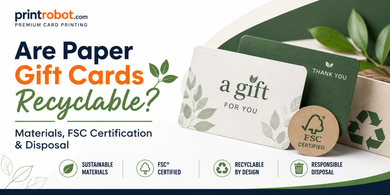
Paper gift cards are physical gift cards made from engineered paper instead of standard PVC plastic.
For businesses, the challenge is not just choosing a greener-looking card. It is knowing what the card is made from, whether it can be recycled, and what sustainability claims are safe to make.
In this guide, we’ll break down paper gift card materials, PaprCard™ vs PaprCard™ RECYCLED, FSC® certification, recyclability, and what to know before adding barcodes, QR codes, or magnetic stripes.
Are Paper Gift Cards Recyclable?
Paper gift cards can be recyclable when they are made from recyclable engineered paper and accepted by the local recycling program.
The important detail is that recyclability depends on the finished card. A plain printed paper card may be treated differently from a card with added components such as a magnetic stripe, laminate, or specialty finish.
For Print Robot’s custom paper gift cards, the base PaprCard™ materials are engineered paper options designed to be curbside recyclable. Businesses should still check local recycling rules before making broad recycling claims to customers.
A safer way to think about it is this:
Paper gift cards can offer a recyclable paper-based alternative to standard PVC, but the final disposal guidance depends on the material, card features, and local recycling rules.
What Are Paper Gift Cards Made From?
Paper gift cards are not the same as basic paper vouchers or printed certificates.
A paper voucher may feel thin, fold easily, and look more like a coupon. Engineered paper gift cards are made to feel more substantial. They are usually produced in a CR80 credit-card size, so they feel closer to a traditional physical gift card while using a paper-based material.
Print Robot’s Paper Gift Cards use 28pt engineered paper. This gives the card a thicker feel than ordinary paper and makes it suitable for branded gift-card programs, card carriers, retail counters, hospitality promotions, and customer gifting.
The goal is simple: give businesses a physical card that feels intentional, without relying on standard PVC plastic.
PaprCard™ vs PaprCard™ RECYCLED
Print Robot offers two paper-card material options: PaprCard™ and PaprCard™ RECYCLED.
Both are engineered-paper options, but they use different fiber sources.
| Feature | PaprCard™ | PaprCard™ RECYCLED |
|---|---|---|
| Fiber source | FSC® certified virgin fiber | FSC® certified post-consumer recycled fiber |
| Material type | 28pt engineered paper | 28pt engineered paper |
| Card feel | Clean, premium paper-card finish | Paper-card finish with recycled-content material |
| Recyclability | Designed to be curbside recyclable | Designed to be curbside recyclable |
| Best fit | Businesses wanting a clean paper-card finish | Businesses prioritizing recycled-content material |
The key point is that “recycled” and “recyclable” do not mean the same thing.
A recycled-content card uses recovered material as part of the input. A recyclable card is designed so the finished material can enter a recycling stream where accepted.
A card can be recyclable without being made from recycled content. It can also contain recycled content and still need local recycling guidance after use.
FSC® Certified, Recycled, and Recyclable: What’s the Difference?
These three terms are often used together, but they mean different things.
FSC® certified refers to responsible paper sourcing. It tells you something about where the fiber comes from and how the material supply chain is managed.
Recycled content refers to what the product is made from. PaprCard™ RECYCLED uses FSC® certified post-consumer recycled fiber.
Recyclable refers to what may happen after the card is used. A recyclable paper card is designed to be accepted by recycling programs where the material and finished card configuration are supported.
This distinction matters because businesses need to avoid unclear sustainability claims.
For example, it is safer to say:
- Made with FSC® certified engineered paper
- Recycled-content option available with PaprCard™ RECYCLED
- Designed to be curbside recyclable where accepted
- Local recycling rules may vary
Avoid saying:
- 100% sustainable
- Zero waste
- Compostable
- Biodegradable
- Recyclable everywhere
- Environmentally harmless
Those stronger claims may sound better, but they should only be used when the exact material and finished card configuration support them.
Do Barcodes, QR Codes, or Magnetic Stripes Change Recycling?
Printed features such as barcodes, QR codes, names, and sequential numbers are usually part of the print itself. They help with scanning, redemption, tracking, or customer identification, but they do not add a separate physical layer in the same way a magnetic stripe does.
Magnetic stripes are different. A magnetic stripe is an added card component, so disposal guidance may not be the same as a plain paper card.
That does not mean paper gift cards cannot use these features. It simply means businesses should be specific when talking about recyclability.
A practical way to say it is:
The engineered paper base is designed to be curbside recyclable, but finished cards with added components such as magnetic stripes may require local recycling guidance.
This keeps the message accurate without overpromising.
When Paper Gift Cards Make Sense for a Business
Paper gift cards are a strong fit when the material choice is part of the brand experience.
They can work well for:
- Retail brands that want a physical gift card without standard PVC
- Restaurants, cafes, salons, and spas with seasonal gifting programs
- Hospitality businesses using branded card carriers or packaging
- Corporate gifting programs with material or sourcing requirements
- Brands that want a more substantial option than a paper certificate
- Businesses that want a recyclable paper-based card where accepted
Paper is not automatically the right fit for every program. If a card needs to handle heavy long-term use, rough handling, moisture, or repeated wallet storage, the business may still need to compare other card materials.
But for many gift-card programs, engineered paper offers a useful balance: a premium card feel, paper-based sourcing, recyclable material potential, and support for common card features.
Businesses can review Print Robot’s Paper Gift Cards made with PaprCard™ when they are ready to compare material options and available card features.
Paper Gift Card FAQs
Are paper gift cards recyclable?
Paper gift cards made from recyclable engineered paper can be designed for curbside recycling, but local recycling rules vary. Cards with added components, such as magnetic stripes, may require additional disposal guidance.
Are paper gift cards made from recycled paper?
Not always. PaprCard™ is made from FSC® certified virgin fiber. PaprCard™ RECYCLED is made from FSC® certified post-consumer recycled fiber.
What is the difference between recyclable and recycled?
Recyclable means the finished material may be accepted into a recycling stream where local programs support it. Recycled means the product contains recovered material as part of its input.
What does FSC® certified mean for paper gift cards?
FSC® certification relates to responsible sourcing of paper fiber. It does not automatically mean the finished card is recycled, compostable, or recyclable everywhere.
Do barcodes or QR codes affect recyclability?
Printed barcodes and QR codes are part of the printed card design. They are different from added physical components, but businesses should still check local recycling guidance for the finished card.
Do magnetic stripes affect paper gift-card disposal?
They can. A magnetic stripe is an added component, so disposal guidance may differ from a plain paper card. Businesses using magnetic stripes should use qualified recyclability language.
Are paper gift cards compostable?
Do not assume paper gift cards are compostable unless the material supplier provides documentation for that exact claim. A paper-based card can be recyclable without being compostable.
Are paper gift cards better than paper certificates?
Paper gift cards usually feel more durable, more branded, and more card-like than basic paper certificates. They can also support features such as barcodes, QR codes, numbering, variable data, or magnetic stripes depending on the selected configuration.