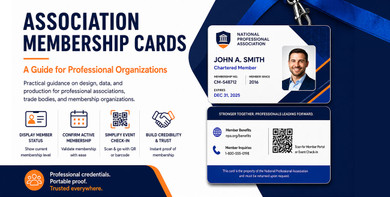
An association membership card is a personalized, printed credential issued to members of a professional body, trade association, chartered institute, chamber, union, or alumni association. It confirms active membership status, displays the member's grade, and provides portable proof of standing for use at events, in the workplace, and during procurement or employer verification.
Why Association Membership Cards Have Distinct Requirements
Most membership cards verify access or unlock a discount. A professional association membership card carries status and often does both.
Members of a professional body hold a defined membership level such as student, associate, charter, staff, fellow, or chartered member. The membership level is often the most important field on the card and one of the clearest ways association cards differ from general membership cards.
The expiration date carries equal weight. In a professional body context, an in-date card confirms the holder has paid their dues or made a donation to the association to earn their status.
What to Print on a Professional Association Membership Card
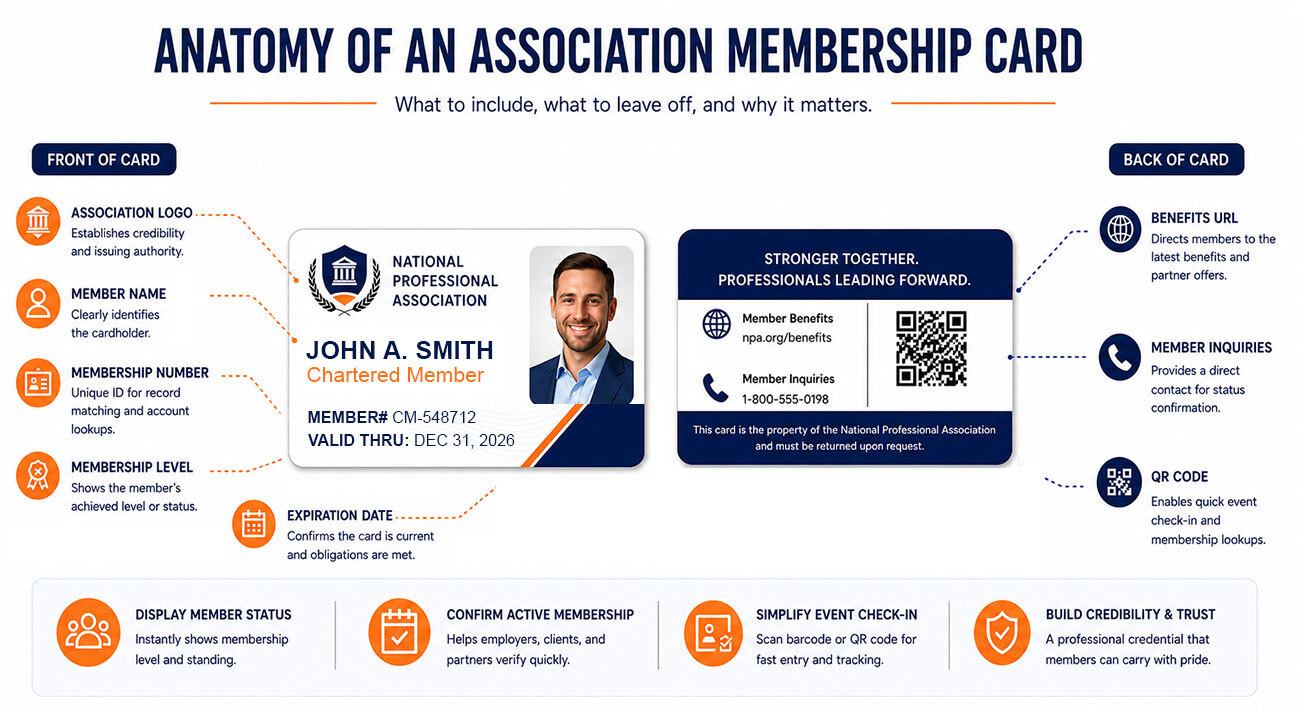
Front of Card
|
Field |
Purpose |
|---|---|
|
Member full name |
Personal identification |
|
Association name and logo |
Issuing body identity |
|
Unique membership number |
Record matching and active status confirmation |
|
Membership grade |
Professional status and seniority |
|
Expiration date |
Annual compliance confirmation |
Write the membership level in full where the layout allows - especially for Lifetime or VIP levels.
The "member since" year is optional but worth including for established bodies. Long standing membership at Fellow or Chartered level signals experience and costs nothing to print.
Post-Nominal Designations
Many members of professional bodies use designatory letters after their names: MRICS, MCIPD, MCIPR, and FCIOB. Whether those appear on your card is a policy decision, not a design one.
If your body awards the designation, include it. The card, the member’s status, and the designation come from the same source and reinforce each other.
If the designation is issued by a separate regulatory or certifying body, omit it. Printing another body's designation alongside your own branding creates ambiguity about who issued what.
What Does Not Belong on the Card Front
Keep the front focused on identity. These elements clutter the design and become outdated quickly:
- Benefits lists
- Discount terms
- Website addresses
Everything functional goes on the back.
Back of Card
- Benefits URL: Print a link to your member benefits page rather than listing the benefits directly. Partner arrangements, CPD requirements, and discount schemes change often. A URL stays accurate after the card has been printed.
- Member inquiries contact number: Employers, procurement teams, and event organizers who need to confirm active membership should be able to reach you without the member having to explain the process themselves.
- QR code: Link it to your member portal or event check-in system. This supports faster registration and status checks without affecting the design on the front of the card.
How Association Membership Cards Are Used
Event Check-In and Conference Registration
Professional bodies run AGMs, CPD days, annual conferences, and regional branch meetings. A card with a barcode or QR code allows event staff to scan rather than search a name list. At a conference with several hundred delegates arriving in a short window, that difference matters. Think about how the card should function and incorporate those specifications at the design stage.
Membership Level Display at Industry Events
At conferences, branch meetings, and networking events, the card helps other attendees recognize the holder’s current membership level quickly.
Employer and Procurement Verification
Employers, clients, and procurement teams may need quick confirmation that a member is current and in good standing. A card that shows the name, membership number, grade, and expiration date makes that check faster.
The Rolling Enrollment Problem and How Professional Associations Handle It
Most professional bodies do not have a single renewal date. Members qualify at different times of year, join after a conference, or register online throughout the year. Chambers and trade associations face the same pattern: new members join continuously rather than in a single cohort.
Printing a single annual batch of cards does not serve this. You end up delaying issuance, over-ordering to keep cards on hand, or running small ad hoc batches at inconsistent quality.
The Card Shell Program
For associations with rolling joins, renewals, replacements, or mixed membership types, print planning matters as much as card design.
You print a larger batch upfront with all static design elements: association branding, logo, grade layout, card structure. Member data is left blank. The shells are held in inventory by your printer. Whenever a new batch of cards is needed, you send a data file. The shells are personalized on-demand and returned to you or mailed directly to the member, typically within a week.
For professional associations and trade bodies, this works because:
- Quality is consistent across every issuance throughout the year
- Fulfillment is integrated into your new member welcome pack
- Replacement cards are handled from the same stored inventory without a separate reprint order
Individual Member Cards vs. Corporate Member Cards
Professional bodies, trade associations, and chambers often carry both individual and corporate memberships. The card fields and design treatment differ between them.
| Individual Member Card | Corporate Member Card | |
| Name | Personal name | Individual name plus organization name |
| Grade | Personal grade displayed | Omitted if not personally assessed |
| Reference number | Personal membership number | Corporate membership reference |
| Design treatment | Standard | Distinct color or layout variation recommended |
Corporate memberships change when staff join or leave an organization. On-demand personalization matters more here because the data changes more frequently than it does for individual members.
A distinct design treatment for corporate cards, even a minor one such as a color band or layout variation, prevents confusion at events and reflects the different nature of the membership relationship.
When a Batch Order Makes Sense vs. When Shell Stock Works Better
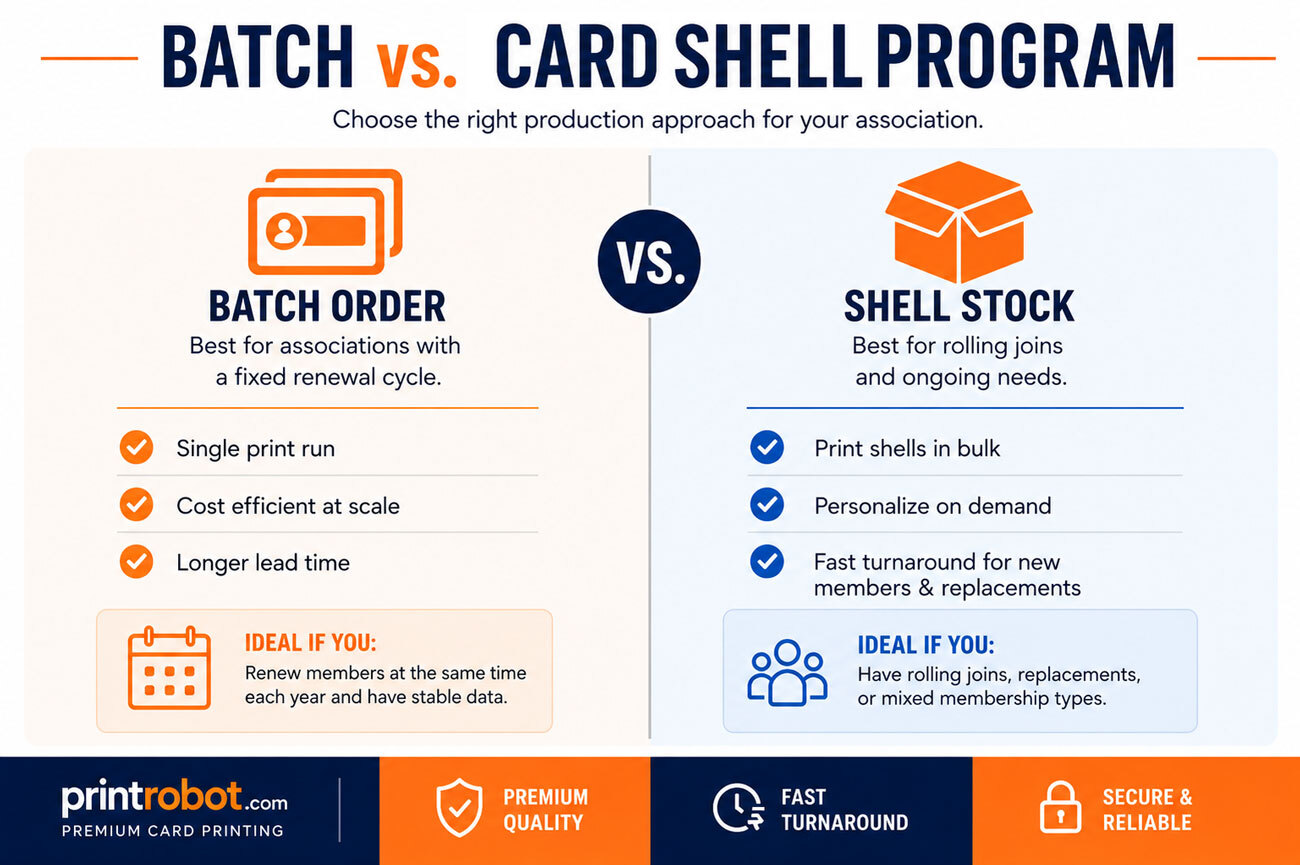
Use a single batch order when most memberships renew at the same time and your cardholder data is stable.
Use a shell program when members join throughout the year, replacements are common, corporate contacts change regularly, or you want cards issued without a minimum quantity or having to wait until the next full print run.
Physical Cards vs. Digital Cards
Digital cards work well as a supplement for event check-in or quick mobile verification. For professional associations, the physical card is the primary credential.
Many professional bodies still prefer a physical card because it is easy to carry, simple to present at events, and familiar in formal review settings. That makes it different from purely digital schemes used in retail or fitness programs.
Issue the physical card as the primary. It still adds value and credibility. Add a digital option where it solves a specific operational need.
What to Prepare Before Ordering
Before requesting a quote or approving artwork, confirm the details below so your order structure matches how your association actually issues cards.
- Member data structure: Confirm which fields will be personalized and whether corporate members need a separate format or card variant.
- Joining pattern: A fixed annual cycle usually orders single batch printing, while ongoing issuance usually works better with a shell card program combined with on-demand personalization. Decide this before briefing your printer.
- Design assets: Logo at 300 dpi minimum. Brand colors in CMYK or Pantone. Grade-specific design decisions confirmed.
- Back-of-card content: Benefits URL, contact number, QR destination. Confirm all of this before the design is finalized.
- Fulfillment preference: Central delivery to your office or direct mail to each member. This shapes the order structure and turnaround time.
For most professional bodies, the best association membership card setup includes the member’s full name, membership number, grade, and expiration date on the front, with status confirmation, contact information, or event functionality on the back.
FAQ
Should post-nominal designations appear on a professional association membership card?
Only if your body awards the designation. If it originates from a separate regulatory or certifying body, omit it to avoid confusion about who issued what.
What is the standard card size for a professional association membership card?
The CR80, at 3.375” x 2.125” is the standard size for most plastic membership cards. This is the same size as a credit card.
What is a Card Shell program?
A print model where cards are produced with all static design elements but without personalized member data. Shells are held in inventory and personalized on-demand as members join or renew throughout the year.
Can association membership cards include a member photo?
Yes, through variable data printing a photo can be added to each card if needed, however, this does add to the cost
How are replacement cards handled?
If shell stock is held in inventory, replacement cards can be personalized and reissued without starting a full reprint order. That makes replacements quicker and easier to manage since there are no minimum quantities.
Can one design cover both individual and corporate members?
It can, but a distinct treatment for corporate cards is recommended. The data fields differ and a visual distinction avoids confusion during event check-in and verification.
Next Steps
If your association is in need of custom membership cards, consider Print Robot. Offering free design services, affordable pricing, and proudly manufacturing in the USA.
Get started with free design services or request a custom quote to fit your needs.