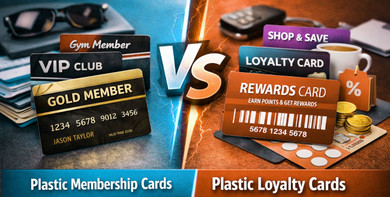
What's the Difference and Which One Does Your Business Need?
The terms are used interchangeably in some conversations, but they are not the same thing. A membership card proves identity and grants access. A loyalty card tracks purchases and rewards repeat behavior. The program behind each card is different, the way the cards function is different, and the signal it sends to the person carrying it is different.
If you are deciding which card type makes more sense for your organization, this guide compares membership cards and loyalty cards side by side, explains where each one fits, and helps you choose the right option.
For a full overview of membership cards specifically, see our complete guide: What are Membership Cards
What Is a Membership Card?
A membership card identifies someone as an active member of a paid or approved program. It is usually personalized and often used to confirm access, status, tier, or renewal eligibility.
Typical examples include gyms, clubs, museums, associations, nonprofits, and other programs where identity, access, or membership status matters.
What Is a Loyalty Card?
A loyalty card is designed to reward repeat purchases or repeated engagement. It usually tracks buying behavior, visits, or points rather than proving identity.
These programs are often free to join and are common in retail, coffee shops, restaurants, supermarkets, airlines, and other high-frequency purchase environments.
Core Differences at a Glance
If you only need the quick answer, this side-by-side comparison shows the main differences.
|
Membership Card |
Loyalty Card |
|
|
Primary function |
Identity + access + belonging |
Transaction tracking + rewards |
|
Cost to join |
Paid (annual, monthly, or one-time) |
Free in most cases |
|
Benefits start |
Immediately on joining |
Earned over time through activity |
|
Card personalization |
Unique per member: name, ID, tier, expiration |
Unique account number only |
|
Encoding used |
RFID, NFC, or barcode for access control if needed |
Magnetic stripe, QR code, or barcode for POS |
|
Expiration date |
Optional depending on membership type |
Usually absent or points-only expiration |
|
Identity verification |
Yes, member name, photo optional |
No, card is anonymous or account-linked |
|
Access control |
Optional depending on facility and card technology selected |
No, transaction only |
|
Revenue for business |
Membership fee paid upfront |
Drives repeat spending, no direct fee |
|
Each card is personalized |
Not required |
How the Physical Cards Actually Differ
Both cards can use the same physical base format. The real difference is how the card is used, what information appears on it, and whether each card needs personalization.
Membership Card: Front and Back
- Front: organization logo, member's full name, member ID number, tier designation (Standard / Gold / Platinum), expiration date.
- Back: barcode or QR code for facility scan-in, website URL, contact details, signature panel.
- Optional: member photo for identity verification, signature panel, barcode, QR code, magnetic stripe, RFID, or NFC chip for facility scan-in.
- Finish: often chosen to match the brand and the perceived value of the program.
Loyalty Card: Front and Back
- Front: brand logo, card name or program name, tagline, same design printed on every card.
- Back: magnetic stripe for POS swipe, barcode or QR code, terms and conditions, account number.
- Personalization: The card is not typically personalized with unique member names. Only numbers.
- Finish: usually selected for practical distribution and brand consistency.
The Variable Data Difference
This is one of the most practical differences for anyone ordering printed cards. A membership card order usually requires variable data printing because each card carries different member information, such as a name, member ID, tier, or expiration date.
A loyalty card print run does not require personalization for each member. The cards are identical aside from unique account numbers which are typically not tied to customers until they are issued.
Why Membership Cards Often Have Expiration Dates and Loyalty Cards Don't
An expiration date on a membership card is not administrative housekeeping. It is a deliberate retention mechanism.
When a membership card expires, the member reaches a clear renewal point. That structure works differently from a loyalty program because access and status are tied to an active membership period.
Loyalty cards work differently. The points or miles may expire through inactivity, but the card itself does not. There is no annual renewal moment. Customers accumulate and redeem on their own timeline, and the business maintains the relationship through ongoing transaction incentives rather than a formal renewal cycle.
A physical membership card can make the renewal cycle feel more tangible because it gives members a visible reminder of their status, access, and benefits.
When Your Business Needs a Membership Card
Choose a membership card when your program depends on identity, access, status, or renewal.
- Physical access control: your members need to enter a facility, gate, or restricted area. RFID, magnetic stripe, or barcode scan-in requires a personalized encoded card.
- Paid program with annual or recurring commitment: the card validates that commitment and gives it a physical form.
- Identity verification at point of entry: a card with the member's name and/or photo confirms who is presenting it for added security.
- Tiered structure: different tiers need different card designs. Silver, Gold, and Platinum can each have a distinct card. That is not possible with a generic loyalty card.
- Belonging is part of the value: For associations, nonprofits, and professional bodies, the card supports identity as much as access.
- Annual renewal as a business model: the expiration date on the card is your renewal trigger. It works passively, without a single reminder email.
When Your Business Needs a Loyalty Card
Choose a loyalty card when the goal is to increase repeat purchases, visit frequency, or customer retention.
- High transaction frequency: customers visit multiple times per week or month. Coffee shops, gyms with retail, supermarkets, quick-service restaurants.
- Free to join, mass participation: no fee barrier. You want every customer in the program, not just committed members.
- POS integration: magnetic stripe loyalty cards integrate directly with most point-of-sale systems for automatic points tracking on every transaction.
- No identity required: the card tracks spending behavior, not who the person is. Anonymous participation is acceptable.
- Reward accumulation model: the value to the customer builds over time. A single visit earns a stamp. Ten visits earn a free item.
Can You Run Both? Hybrid Programs Explained
Yes. Many successful businesses run both simultaneously, and some of the most recognized programs in the world blur the line between the two.
Costco requires a paid annual membership to enter the store. That membership card is the access credential. But inside the store, Costco also tracks spending and offers executive cashback rewards. One membership that functions as both.
Amazon Prime is a paid membership: you pay annually, benefits activate immediately (free shipping, Prime Video, etc.). It also generates loyalty behavior: members spend significantly more on Amazon than non-members because their upfront commitment creates preference. The card equivalent here is a digital credential, but the program structure is hybrid.
A gym with a retail section might issue membership cards for facility access (RFID barcode for turnstile) and separately run a loyalty scheme on in-gym retail spend (protein supplements, apparel). Members carry one credential that grants access; their retail purchases earn points tracked in a POS system.
For printed cards, running both programs means either two separate card orders: one personalized membership card and one generic loyalty card, or a dual-encoded card that carries both a barcode for access control and a magnetic stripe for POS integration. The right choice depends on which systems your facility uses.
Industry Breakdown: Which Card Type Fits Each Sector
|
Industry |
Card Type |
Reason |
|
Gyms and fitness centers |
Membership |
RFID or barcode scan-in at turnstile, annual renewal, identity at front desk |
|
Coffee shops |
Loyalty |
High visit frequency, free to join, stamp or points model |
|
Golf and country clubs |
Membership |
Paid annual, premium finish signals club quality, identity at gate |
|
Supermarkets |
Loyalty (or hybrid) |
Free program, transaction-based points, no identity required |
|
Museums and galleries |
Membership |
Annual pass, access control, family card with multiple names |
|
Car washes |
Membership |
RFID automated bay entry, unlimited wash plan, no staff at point of entry |
|
Casual restaurants |
Loyalty |
Repeat visit reward, punch or points model, free to join |
|
Fine dining / VIP restaurants |
Membership |
Exclusivity, paid program, identity signal, premium card finish |
|
Spas and wellness centers |
Membership |
Paid tiered access, RFID or barcode for treatment booking |
|
Airlines |
Loyalty with membership tier |
Free to join, earn miles per flight, tier status acts as membership layer |
|
Professional associations |
Membership |
Identity credential, annual renewal, professional standing |
|
Nonprofits and charities |
Membership |
Donor identity, annual renewal, community belonging |
Frequently Asked Questions
1. What Is The Main Difference Between A Membership Card And A Loyalty Card?
A membership card confirms status, access, or paid participation in a program. A loyalty card is used to reward repeat purchases or repeat visits over time. In simple terms, one supports membership, while the other supports customer retention.
2. Which Businesses Should Use Membership Cards Instead Of Loyalty Cards?
Membership cards make more sense for businesses or organizations that need identity, access, tiering, or renewal control. Common examples include gyms, clubs, museums, nonprofits, associations, spas, and other programs where member status needs to be verified.
3. Which Businesses Should Use Loyalty Cards Instead Of Membership Cards?
Loyalty cards are usually the better fit for businesses that want to increase repeat purchases, visit frequency, or customer retention. They work well for coffee shops, restaurants, retail stores, supermarkets, pharmacies, and other high-frequency purchase environments.
4. Can One Business Use Both A Membership Card And A Loyalty Card?
Yes. Some businesses run both at the same time. A membership card can handle access, identification, or member status, while a loyalty card or loyalty function can track spending and reward repeat purchases. This setup is common when a business wants both access control and customer retention.
5. Why Are Membership Cards Usually Personalized While Loyalty Cards Often Are Not?
Membership cards are usually personalized because they need to identify a specific member and may include a name, member ID, tier, or expiration date. Loyalty cards are often printed in one standard design with an account number added so they are used to track account activity rather than visually confirming identity.
6. Are Membership Cards Better For Access Control?
Yes. Membership cards are usually the better choice when a business needs scan-in, facility access, gate entry, or member verification. Loyalty cards are more commonly tied to point of sale activity, rewards tracking, or repeat-purchase behavior.
7. How Do I Choose Between A Membership Card And A Loyalty Card For My Business?
Start with the business model. Choose a membership card if your program depends on identity, access, exclusivity, status, or renewal. Choose a loyalty card if the main goal is to encourage repeat spending, repeat visits, or ongoing customer engagement.
Conclusion: Membership Cards vs Loyalty Cards
A membership card and a loyalty card are both physical PVC plastic credentials. The material is the same. The format is the same. What differs is the program behind the card, the function encoded into it, and the relationship it represents.
Membership cards own identity, access, and belonging. Loyalty cards own transactions, rewards, and repeat behavior. Some businesses need one. Some need the other. Some need both.
If you need personalized cards with member names, expiration dates, and/or access control encoding, Print Robot prints both custom membership cards and loyalty cards. They can be produced in a single batch and shipped out or produced over time using on-demand personalization and fulfillment services to assist with distribution directly to customers or members.
Free design services are included and all products are proudly manufactured in the USA. Standard turnaround is 10 - 15 business days, on-demand personalization can be turned around faster with fulfillment services.