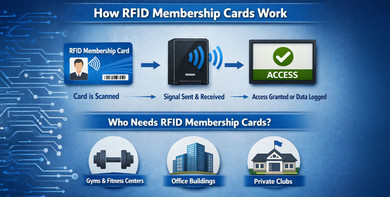
Most membership cards require some kind of action at the point of entry. A member pulls out the card, holds it up to a scanner, or hands it to staff. RFID membership cards skip that step. A member walks up to a turnstile or drive-through gate, and the system does the rest. No barcode scan. No magnetic stripe swipe. No staff interaction.
That difference matters in some programs and is irrelevant in others. This guide covers how RFID membership cards work, what you need to confirm before ordering them, and which types of organizations actually benefit from making the switch. For background on membership card types and encoding options generally, read our complete guide here.
What Is an RFID Membership Card?
An RFID membership card is a standard CR80 plastic card with a microchip and antenna embedded inside. This is the same technology used inside a plastic hotel key card.
RFID communicates with a compatible reader using radio waves, without physical contact. The reader emits a radio frequency field, the card's antenna picks it up and uses that energy to power the chip, and the chip transmits the member's unique identifier back to the reader. The system confirms that access is approved, logs the visit, and opens the gate, or releases the turnstile. The whole exchange takes under a second.
From the outside, the card looks identical to any other PVC membership card. The chip is embedded in the center layer of the plastic and is barely visible to the naked eye. There are no raised components, no ports, and no battery. The card is the same 3 3/8" x 2 1/8" CR80 size and 30 mil thickness as a standard membership card, and it fits in any wallet.
ISO/IEC 14443A compliance: This is the international standard that governs how 13.56 MHz contactless cards communicate with readers. A card that is ISO/IEC 14443A compliant will work with any reader built to the same standard, which covers most modern gym systems, hotel key card hardware, and access control equipment from the past decade. Print Robot's RFID cards are 13.56 MHz with 1k bytes of storage, ISO/IEC 14443A compliant.
The chip stores a unique member identifier, not personal data. Name, contact details, and membership records live in your membership management system. The card simply carries the ID that links to that record.
13.56 MHz vs 125 kHz: Why the Frequency Matters Before You Order
RFID cards operate at one of two frequency ranges for membership and access applications. The cards and the readers must match. A 13.56 MHz card will not communicate with a 125 kHz reader, and vice versa. Getting this wrong means the cards you order will not work with your existing hardware.
|
Frequency |
Read range |
Common use |
|
13.56 MHz (HF/NFC) |
~ 1.5 inch tap range |
Modern gym turnstiles, hotel readers, access control hardware from the last decade. NFC-compatible. Print Robot's offered frequency. |
|
125 kHz (LF) |
~ 4 inch proximity |
Legacy gym systems, older car wash gates, basic proximity readers. Not NFC-compatible. |
How to find your reader's frequency: Check the specification sheet for your access control hardware, gym management system, or car wash gate reader. It will list the supported frequency. If you cannot locate the spec sheet, contact the hardware manufacturer directly with the model number. This is the single most important thing to confirm before placing an RFID card order.
Print Robot can provide some blank test samples before ordering to ensure compatibility.
If you are installing new access control hardware alongside new cards, specify ISO/IEC 14443A compatibility when purchasing the reader. This ensures your cards and hardware will work together out of the box.
How Do RFID Key Cards Work?
When a member holds the card within read range of an RFID reader, the reader emits a radio frequency field. The card's antenna picks up that field and uses it to power the embedded chip. The chip transmits the stored member ID to the reader, which passes it to the access control or membership management system to ensure that access is granted. The gate opens or the visit is recorded. No battery in the card. No swipe. No line of sight required.
Read range at 13.56 MHz: Approximately 1.5 inches. The member taps or holds the card close to the reader face. This is different from 125 kHz systems, which read at up to 4 inches and can trigger from a card in a shirt pocket. At 13.56 MHz, the member needs to bring the card close to the reader deliberately, which reduces the chance of accidental triggers in high-traffic areas.
Passive operation: Membership RFID cards are passive, meaning they contain no battery. The reader's electromagnetic field powers the chip each time it comes into range. The card requires no charging and has no moving parts. Under normal use, a 30 mil PVC RFID card will last as long as a standard membership card: three to five years.
What is stored on the chip: The chip holds a unique identifier, typically a member ID or access code. It does not store names, payment data, or personal information. All of that sits in the backend system the reader is connected to. The card is the key. The system behind it holds the record.
Programming is separate from card production: An RFID card is produced with the chip embedded, but in many instances, the chip needs to be programmed with each member's unique ID before or after the cards are produced. Card production and chip programming are two separate steps. Print Robot's base card pricing does not include programming. If your access control vendor handles programming, they will need the blank cards. If you need programming handled as part of the order, contact the team to discuss the encoding requirements.
When Does an RFID Membership Card Actually Make Sense?
RFID is not the right choice for every membership program. It adds cost and a programming requirement that simpler programs do not need. The question is whether the operational benefit of hands-free entry justifies that for your specific setup.
RFID makes sense when:
- Entry happens at an unmanned point: car wash bay gates, gym turnstiles, gated parking, or building access without staff present
- Member throughput at entry is high enough that individual barcode scans or front-desk check-in creates a bottleneck
- Your access control hardware is already RFID-enabled, or you are installing new readers alongside new cards
- You want automated visit logging without any action required from the member beyond carrying the card
RFID is not necessary when:
- Check-in happens at a staffed desk where a barcode scan takes the same amount of time
- Your membership management software does not support RFID readers
- The card's primary function is identification or brand presentation, not access control
For most small to mid-size programs with a staffed front desk, a barcode membership card handles check-in just as effectively at a lower cost and without the programming step.
Which Organizations Use RFID Membership Cards?
RFID membership cards fit programs where the entry point is the key operational challenge. These are the verticals where that friction point is most common.
Car washes with unlimited plans: RFID is the operational backbone of unlimited car wash membership programs. A member drives up, the card in the windshield or on the dashboard triggers the gate reader, and the bay opens. No staff at the entry point. No action required from the driver. Without RFID, an unlimited plan requires either a staffed entry lane or a member to scan a barcode manually, both of which introduce friction that undermines the program. Car washes may benefit from a windshield decal containing an embedded technology chip rather than a card so membership cannot be transferred across multiple drivers.
Gyms and fitness centers with turnstiles: 24-hour gyms and high-volume fitness facilities use RFID turnstiles to handle entry without front-desk staff at every hour. Members tap or hold their card to the reader post and the turnstile releases. During peak hours, this eliminates the line that forms when staff have to manually check in each member or scan barcodes one by one.
Gated parking and facility access: Any facility where a physical barrier controls access and the member count is too high for manual gate operation. The card tapped at the entry reader raises the arm. The same model as a car wash, but applied to parking lots, private roads, or facility zones with restricted access.
Hotels or country clubs with combined room access and membership credentials: A single card functions as both the room key and the membership or loyalty program credential. The member uses one card for everything: room access, gym entry, parking, golf pro shop, and loyalty recognition at the front desk or point of sale. Hotels issuing combined-function cards need to coordinate card programming with their property management system.
Museums and cultural institutions with members-only zones: After-hours member access, members-only exhibition entry, or unstaffed archive access all benefit from RFID. The card reader controls who gets in without requiring a staff member to be present.
What to Confirm Before You Order RFID Membership Cards
RFID orders have a few requirements that standard printed card orders do not. Going through this checklist before placing an order prevents the most common problems.
- Chip frequency: Confirm your reader's required frequency (13.56 MHz or 125 kHz) from the hardware spec sheet or vendor. Print Robot's most popular RFID cards are 13.56 MHz.
- ISO/IEC 14443A compatibility: Verify this with your access control vendor. Most modern systems support it. Older or proprietary systems may use a different protocol.
- Programming plan: Decide who handles chip programming and when. Card production and programming are separate. If your access control vendor programs the chips, they receive blank cards ready to be programmed. If programming needs to happen before card delivery, discuss this with the team at the order stage.
- Card design: The RFID chip is invisible from the outside and does not restrict design placement. Your logo, member name, ID, expiry date, and barcode can all be printed on the card surface exactly as they would appear on a standard membership card.
- VDP for printed fields: Personalization of the member name, ID, and expiration date printed on the card surface are handled through variable data printing, separate from chip encoding. If each card needs personalized printed fields, a data file (CSV or Excel) is required at the time of order.
Related: What Is Variable Data Printing? A Membership Card Guide for Organizations
What Is the Difference Between an RFID Card and a Regular Membership Card?
A regular membership card stores information as printed text, a barcode, or a magnetic stripe. All of these require the card to be physically presented to a reader or a staff member. An RFID membership card stores a unique identifier on an embedded chip that communicates wirelessly with a reader within read range. No physical contact required. The card works regardless of orientation.
The practical difference is in what happens at the entry point. A barcode card requires the member to hold the card up to a scanner at the right distance and angle. An RFID card just needs to be near the reader. For a staffed desk, that difference is small. For an unmanned turnstile or gate, it is the entire system.
Can RFID and barcode coexist on the same card? Yes. A card can carry both a printed barcode on the surface and an embedded RFID chip. The barcode handles check-in at staffed front desks or handheld scanners. The RFID chip handles automated turnstile or gate entry. Both read the same member ID. For facilities with both staffed and unstaffed entry points, this dual-format card removes the need for members to carry two cards.
Related: Types of Membership Cards: Which One Is Right for Your Program?
Summing Up: Is RFID Right for Your Program?
RFID membership cards solve a specific problem: entry points where physical scanning or manual check-in is too slow, too staff-intensive, or not possible. Car wash gates, gym turnstiles, and gated facility access are where RFID earns its cost. For programs where a staffed desk handles all check-ins, a barcode card covers the same ground at lower cost and without the programming requirement.
If your program involves any form of unmanned access control, RFID is worth ordering. The first step is confirming your hardware's chip frequency before placing the order. From there, the card itself is the same format as any other PVC membership card: same size, same durability, same print options for the surface.
Custom RFID membership cards with 13.56 MHz chips, ISO/IEC 14443A compliance, and full surface printing are available at printrobot.com/rfid-key-cards/.
Order Custom RFID Membership Cards
Print Robot produces custom RFID membership cards in the USA with a standard 10 to 15 business day turnaround. The most popular configuration includes cards that are 30 mil PVC, CR80, gloss finish, with an ISO/IEC 14443A compliant 13.56 MHz chip. Rush production is available. Request a free sample kit and test cards to ensure compatibility or get started with complimentary design services.
Call us now: 800.547.6624
Order directly: printrobot.com/rfid-key-cards/