
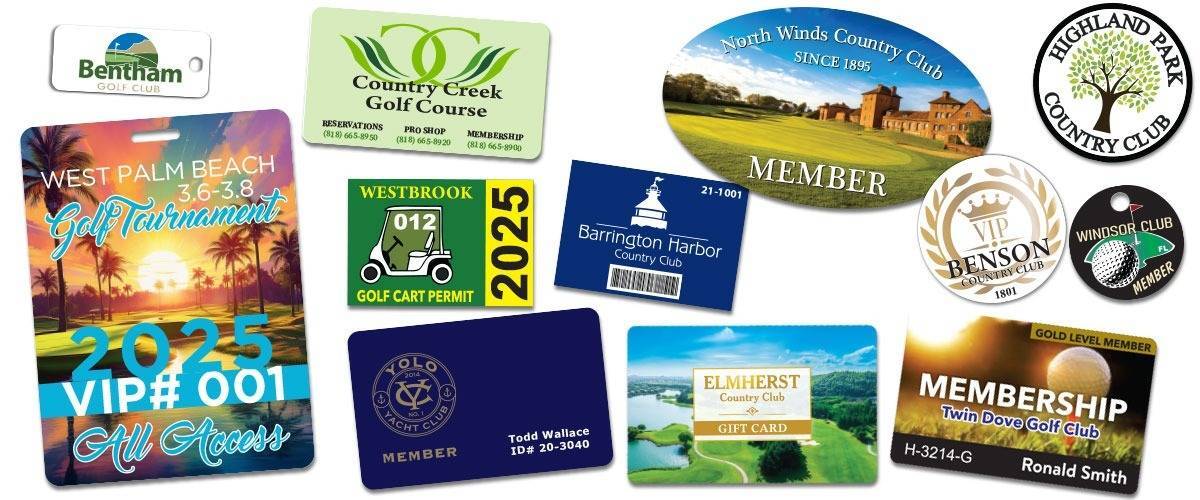
A golf club membership card does more work than it gets credit for. It proves identity at the bag drop, confirms tier access at the pro shop, shows up at the locker room and grill room, and carries the club's exclusive brand in a member's wallet every day between visits.
Getting it right means making deliberate decisions: what goes on the front, which features actually match how the club operates, and how to produce a card that holds up to daily use while presenting the upscale look your club desires.
This guide works through those decisions for golf club managers, membership directors, and club operators who already know they need cards and want to know how to do them well.
Why Golf Clubs Approach Membership Cards Differently
Most membership programs have one scan-in moment. Golf clubs have several: course check-in, cart barn, locker room, pro shop, and dining. The card may be referenced at every one of those points in a single visit, by different staff members who need to confirm the same things quickly: who this person is and what their access level covers.
That multi-touchpoint reality means the card has to be legible at a glance and finished well enough to hold up in an environment where presentation matters. A card that looks worn or generic sits uncomfortably in a wallet next to a platinum Amex, and it says something about the club before a member even opens their mouth.
What Should a Golf Club Membership Card Include?
Essential fields on every card
Club name and logo. Front, prominent. The card represents the institution.
Member name. Personalization is non-negotiable at private club level. A generic card feels like a budget decision.
Member number. Required for account-linked check-in, pro shop charges, and management system integration.
Membership tier. Full Golf, Social, Corporate, Junior: whatever categories the club uses, this needs to be clearly visible so staff can confirm access at a glance without a system lookup.
Expiration date. Drives renewal behavior naturally. Also helps staff flag expired credentials without needing to pull up an account.
Optional fields worth considering
Member photo. Worth it at clubs with large memberships, high staff turnover, or resort-style traffic where face recognition is unreliable. If each card includes unique names, photos, account numbers, or expiration dates, that usually means working with variable data printing.
Member since date. A quiet prestige signal for legacy members. Costs nothing to add and matters to the members most likely to renew indefinitely.
Secondary member label. Spouse and family cards should link visibly to the primary account number so that pro shop charges and locker assignments route correctly.
Guest or day pass designation. Any temporary credential should be visually distinct from a standard member card so staff know the access limits immediately.
Reciprocal access note. A small printed designation reduces friction at partner courses for clubs in reciprocal programs.
Front and back: a quick reference
|
Card Front |
Card Back |
|
Club name and logo |
Barcode, QR code, or Magnetic Stripe (Depending on type of scan-based check-in) |
|
Member name |
Signature panel (optional for account verification) |
|
Member number |
QR code linking to member portal or tee times |
|
Tier designation |
Club website or contact |
|
Expiration date |
Member benefits summary (optional) |
The back of a golf club card is consistently underused. A QR code linking to the member portal, tee time booking, or the events calendar adds real utility. The destination URL can be updated any time without reprinting cards. If your team is still deciding between standard printed cards, magnetic stripe cards, barcode cards, QR cards, or RFID cards, it may help to compare the main types of membership cards before choosing the final setup.
Card Strategy by Membership Category
Most clubs run several membership categories at once. The card strategy does not need to be different for each one, but a few targeted decisions make a real difference operationally and from a member experience standpoint.
|
Category |
Card priority |
Key design note |
|
Full Golf |
Highest quality finish, full personalization, clear tier designation |
This card sets the standard. Matte or spot UV signals premium without being loud. |
|
Social |
Same quality finish as Full Golf, clear Social designation |
Match quality to avoid making social members feel like a lesser tier. Color differentiation helps staff confirm access quickly. |
|
Corporate |
Individual names, linked to corporate account number |
Cards are used for client entertainment. Quality reflects on the company as much as the club. |
|
Junior / Young Executive |
Match Full Golf quality, clear tier designation |
A card that looks second-tier hurts retention in this category. The tier label handles access; the finish communicates inclusion. |
|
Spouse / Family |
Individual name, linked to primary account number |
Access designation should reflect actual access rights, not a secondary status label. |
|
Non-Resident / Weekday |
Clear access designation on the front |
Prevents front-desk friction. The card communicates the access rule so the staff does not have to. |
For tier visual differentiation without creating separate artwork: use a different accent color bar or background treatment per tier, or vary the finish (spot UV for Full Golf, matte for Social, for example). The card layout and branding stay consistent. Only the tier signal changes. It could also be as simple as adding a line of text listing the membership type.
Which Features Does Your Club Actually Need?
Match features to how the club operates, not to what is available. The right question is whether the card needs to do anything beyond being presented visually.
Manual vs. Scan-based Check-in
If staff knows the members and check-in is handled by sight, a well-printed personalized card with a clear tier designation is sufficient. No encoding needed.
Scan-based check-in makes sense when the club wants to track visitor data, connect to a management system, or handle a volume of daily check-ins that manual verification cannot keep up with. Before specifying encoding, confirm which format the club's POS or management software reads.
Barcode vs. QR code
A barcode is the standard choice for fast scan-in at the pro shop or check-in desk. A QR code is more flexible for member-facing use: it can link to the member portal, tee time booking, or event calendar, and the destination can be updated without reprinting cards. If you are weighing those barcode vs. QR code tradeoffs more closely, it helps to look at them outside the golf-club context as well.
Photo ID
Useful at clubs with 500+ members, high seasonal staff turnover, or multi-facility access where recognition is not reliable. At a 200-member club where the head pro knows every face, it adds overhead without adding value.
Embossing and Signature Panels
Embossed member numbers add a tactile, credit-card quality that fits high-initiation-fee environments. Embossing has been phasing out in recent years as credit cards have done away with this treatment and moved towards flat printing. Signature panels are practical for clubs where the card is presented at the grill room or bar for account charges. Neither is necessary for every club, but both make sense at full-service private and country clubs.
RFID
RFID is the right choice when automating access at a specific unstaffed point, such as a gated cart barn, electronic locker room lock, or facility entrance outside operating hours. If your club is actively evaluating RFID membership cards, that decision is worth looking at in more depth before adding the feature. It is especially useful when door access control is needed, however, the right systems must be in place for RFID technology to be functional.
Card Finish and Design
At a private club, the card is seen by other members and presented in fine-dining and pro shop settings. That raises the standard compared to a gym key tag. The design should feel continuous with the club's existing brand: the same colors, the same logo treatment, the same tone as the clubhouse stationery and tournament materials.
Choosing a finish
|
Finish |
What it communicates |
Best for |
|
Gloss |
Vibrant, high-shine, saturated colors |
Clubs with bold color schemes or course photography |
|
Matte |
Understated, premium feel, fingerprint-resistant |
Most private and country clubs; holds its quality appearance longer under daily use |
|
Spot UV |
Selective gloss highlights over matte base, tactile and layered |
Full Golf tier cards, premium or legacy member differentiation |
Matte provides a more upscale feel and tends to age better under daily wallet use, which matters for a card that is in and out of a wallet for 12 months. Gloss is the industry standard but it does show fingerprints and minor surface wear more visibly. For the top membership tier at a high-end club, spot UV on a matte base offers the most luxurious option: the logo or crest treated with spot UV creates a unique, tactile quality that members notice immediately.
Common design mistakes
- Overcrowding the front: name, tier, and expiration date should be readable in two seconds across a desk
- Generic stock golf imagery instead of actual club photography or the club's crest
- Fonts that do not match the club's visual identity elsewhere
- Treating all tiers identically when a simple color accent or finish variation would help staff confirm access faster
If you need the deeper production side of layout, front-versus-back planning, and print-ready setup, that belongs in a separate guide on how to design a membership card.
Issuing, Replacing, and Managing Cards
New member onboarding
The card should arrive as soon as possible after a new member joins. A welcome packet with the membership card and a brief orientation note is a better first impression than a temporary credential or a verbal promise that the card is coming.
Most golf clubs do not have all new members joining at once. Members trickle in throughout the year, which makes standard batch printing awkward. A card shell program solves this: pre-printed cards carrying the club's branding are held in inventory, personalized on-demand when a new member joins, and shipped quickly to either the club or directly to the recipient.
Replacements and renewals
Define the replacement policy before it comes up: who requests it, how fast it is fulfilled, whether there is a fee. PVC at 30 mil should last three to five years under normal use.
Annual renewal is the highest-retention moment in the membership year. A new card at renewal reinforces the value of continuing. An expiration date also makes lapsed member management simpler: staff can see at a glance whether a card is still valid without pulling up an account.
Family and secondary member cards
Each family member with access rights should have their own card, linked by account number to the primary member so that charges and records are routed correctly. Spouse and family card designations should reflect actual access rights. A temporary guest credential should look distinctly different from a standard member card so staff can confirm the access limits immediately.
Balancing Prestige and Practicality
PVC at 30 mil thickness handles both requirements: it holds up to daily wallet use, outdoor cart exposure, and a full year of member handling, while looking and feeling like a financial card. That is the right baseline for most golf club cards.
Under-investing is the more common mistake. A generic, low-quality card in a club that charges meaningful initiation fees creates a mismatch that members notice. The card is often the first physical thing a new member receives. That impression is hard to walk back.
Over-engineering is the other direction: RFID, NFC, and other advanced features can add cost and & that some private club check-in models do not need or cannot yet accommodate. Match the technology to the actual operational requirement, not to what the most advanced available option looks like.
FAQ’s
What should be on a golf club membership card?
Most golf club cards should include the club name, member name, member number, membership tier, and expiration date. Barcode, QR code, photo, or spouse/family identifiers only make sense if the club actually uses them operationally.
Do golf club membership cards need a barcode, magnetic stripe, or QR code?
Only if the club uses scan-based check-in, account-linked transactions, or a member portal workflow. If staff verify members manually, a barcode or QR code may not add much value.
Is RFID worth it for a golf club membership card?
Usually only when the card controls access at an unstaffed point, like a gated cart barn, locker room, or after-hours facility entrance. For normal staffed pro shop check-in, RFID is often unnecessary.
What is the standard size and thickness of a golf club membership card?
The standard size is CR80 (3.375” x 2.125”) and 30 mil thick, which is the same size and thickness as a credit card. That format is common for membership cards because it fits wallets easily and holds up well in daily use. Some clubs looking for a more upscale feel will opt for a thicker, more robust card at 40 or 50 mil thick.
Should spouse and family members have separate cards?
Yes, in most cases. Separate cards make it easier to route charges correctly, confirm access rights, and avoid confusion at the pro shop, dining room, or locker area.
How long should a golf club membership card last?
A PVC card at standard thickness should usually last through normal yearly club use and often much longer at 3 - 5 years or more
Do golf clubs need photo ID on the card?
Not always. Photo cards make more sense at larger clubs, resorts, or operations with high staff turnover. At smaller private clubs where staff know members well, photos may add more work than value.
What finish works best for golf club membership cards?
Matte is usually a more popular choice for private and country clubs because it feels premium and hides wear better than gloss. Spot UV works well when the club wants a more elevated flagship-card look.
Ready to Order Golf Club Membership Cards?
Print Robot produces custom PVC membership cards in the USA with free design services included on qualifying orders. For clubs managing year-round onboarding, Print Robot has worked with MANY golf and country clubs like yours and can work with you to develop the perfect solution for your needs. Request a quote on membership cards with on-demand personalization or get started with complimentary design services.